
The seven major pitfalls of Mergers
1. Believing that a merger of equals can happen.
2. Focusing on a strategic fit that you forget to focus on a cultural fit. (Article)
3. The acquirer concedes too much to the acquired, that the acquired ends up calling the shots.
4. Integrating slowly. (A merger should only last about 90 days)
5. The acquirer replaces all the managers of the acquired. (Not considering the talent pool of the acquired company)
6. Paying too much. (Make sure you can recoup your premium)
7. The negative resistors of the acquired company. (The resistors are usually always replaced)
1. Believing that a merger of equals can happen.
2. Focusing on a strategic fit that you forget to focus on a cultural fit. (Article)
3. The acquirer concedes too much to the acquired, that the acquired ends up calling the shots.
4. Integrating slowly. (A merger should only last about 90 days)
5. The acquirer replaces all the managers of the acquired. (Not considering the talent pool of the acquired company)
6. Paying too much. (Make sure you can recoup your premium)
7. The negative resistors of the acquired company. (The resistors are usually always replaced)
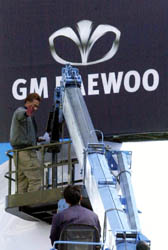
Why has GM embarked on such a strategy? What are the benefits that
the company expects to flow from building strategic alliances with smaller
competitors? Here we list some of the key advantages:
Joint production of engines and new models saves costs
Production economies of scale
Managerial economies of scale
Technical economies of scale
Speedier development times
GM is not alone in this strategy; many of the other large car makers have
started similar projects.
Daimler-Benz took over Chrysler and also control Suzuki and Mitsubishi
Renault and Nissan merged in 1999 and bought Samsung in 2001
Ford owns Volvo cars and Land Rover
But these have tended to be outright takeovers or mergers, involving
greater cost and commitment from the predator firm. GM's policy has
been to acquire parts of smaller competitor car makers. Their aim has
been to achieve a better 'fit' between themselves and the smaller firm.
These so-called 'synergies' between the two companies in a
merger/takeover enable the predator firm to broaden the base of its
product range, so that it has a car for every segment, or type of
customer, in the market. These products can then be given the merged
company's 'brand' (reputation for quality, status in the marketplace and
so on), and can therefore appeal to the different target customers. This
process of 'differentiation' is one of the key ways in which firms compete
in oligopoly markets. Site Source: bized
the company expects to flow from building strategic alliances with smaller
competitors? Here we list some of the key advantages:
Joint production of engines and new models saves costs
Production economies of scale
Managerial economies of scale
Technical economies of scale
Speedier development times
GM is not alone in this strategy; many of the other large car makers have
started similar projects.
Daimler-Benz took over Chrysler and also control Suzuki and Mitsubishi
Renault and Nissan merged in 1999 and bought Samsung in 2001
Ford owns Volvo cars and Land Rover
But these have tended to be outright takeovers or mergers, involving
greater cost and commitment from the predator firm. GM's policy has
been to acquire parts of smaller competitor car makers. Their aim has
been to achieve a better 'fit' between themselves and the smaller firm.
These so-called 'synergies' between the two companies in a
merger/takeover enable the predator firm to broaden the base of its
product range, so that it has a car for every segment, or type of
customer, in the market. These products can then be given the merged
company's 'brand' (reputation for quality, status in the marketplace and
so on), and can therefore appeal to the different target customers. This
process of 'differentiation' is one of the key ways in which firms compete
in oligopoly markets. Site Source: bized
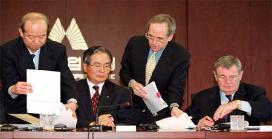
Senior management from Daewoo and General
Motors meet to sign an agreement on General
Motors acquisition of parts of Daewoo.
Title: General Motors Corp and Daewoo Motor
Sign Agreement.
Motors meet to sign an agreement on General
Motors acquisition of parts of Daewoo.
Title: General Motors Corp and Daewoo Motor
Sign Agreement.
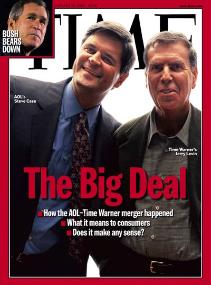
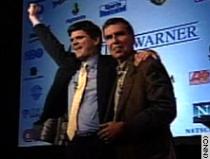
No members of the 2001 Global Influentials class saw their fortunes change more
drastically than Steve Case and Jerry Levin, engineers of the deal that brought
together once-booming Internet portal America Online and media giant Time
Warner Inc.
Many hailed the two men as visionaries when they helped form AOL Time Warner,
the world's largest media company, in 2001. Two years later, both men have left
their positions and the company they helped create has ceased to be, albeit in
name only.
In fall 2003, following a period of poor fiscal performance, AOL was formally
dropped from the name. It was a move the company said was made to "more
accurately represent" their portfolio, but one that many critics claimed was due to
concerns about the AOL unit's poor performance. (Time Warner is CNN's parent
company.)
Yet the two men most closely linked to the merger -- and prime targets when the
company failed to meet many expectations -- had relinquished their day-to-day
roles before the name change. Levin retired in May 2002 as AOL Time Warner's
chief executive officer, while Case stepped down as the company's chairman in
January 2003.
Articles: Thursday, February 3, 2005
drastically than Steve Case and Jerry Levin, engineers of the deal that brought
together once-booming Internet portal America Online and media giant Time
Warner Inc.
Many hailed the two men as visionaries when they helped form AOL Time Warner,
the world's largest media company, in 2001. Two years later, both men have left
their positions and the company they helped create has ceased to be, albeit in
name only.
In fall 2003, following a period of poor fiscal performance, AOL was formally
dropped from the name. It was a move the company said was made to "more
accurately represent" their portfolio, but one that many critics claimed was due to
concerns about the AOL unit's poor performance. (Time Warner is CNN's parent
company.)
Yet the two men most closely linked to the merger -- and prime targets when the
company failed to meet many expectations -- had relinquished their day-to-day
roles before the name change. Levin retired in May 2002 as AOL Time Warner's
chief executive officer, while Case stepped down as the company's chairman in
January 2003.
Articles: Thursday, February 3, 2005
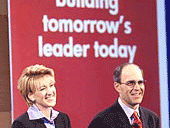
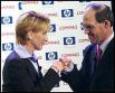
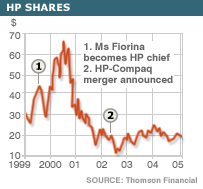
It was when she joined HP in 1999, with a brief to make the venerable computer
hardware manufacturer more profitable, that she really hit the big time.
Despite a huge slump in profits two years after her arrival, when the tech bubble
finally burst, and claims from some quarters that she was "gambling with Silicon
Valley's proudest legacy", Ms Fiorina steered the company towards its $18bn
merger with Compaq.
The move was not without its critics, most notably Hewlett shareholder Walter
Hewlett, heir to one of HP's founders, who failed in an attempt to block the deal in
court. HP's boss relished her success in pulling off the biggest coup in the
industry's history.
"I think transformation requires risk taking. And I think frankly as well, business
success in any industry requires risk taking," she told the BBC at the time.
Articles: April 30, 2002 , February 10,2005
hardware manufacturer more profitable, that she really hit the big time.
Despite a huge slump in profits two years after her arrival, when the tech bubble
finally burst, and claims from some quarters that she was "gambling with Silicon
Valley's proudest legacy", Ms Fiorina steered the company towards its $18bn
merger with Compaq.
The move was not without its critics, most notably Hewlett shareholder Walter
Hewlett, heir to one of HP's founders, who failed in an attempt to block the deal in
court. HP's boss relished her success in pulling off the biggest coup in the
industry's history.
"I think transformation requires risk taking. And I think frankly as well, business
success in any industry requires risk taking," she told the BBC at the time.
Articles: April 30, 2002 , February 10,2005
| Takeovers and Mergers |